
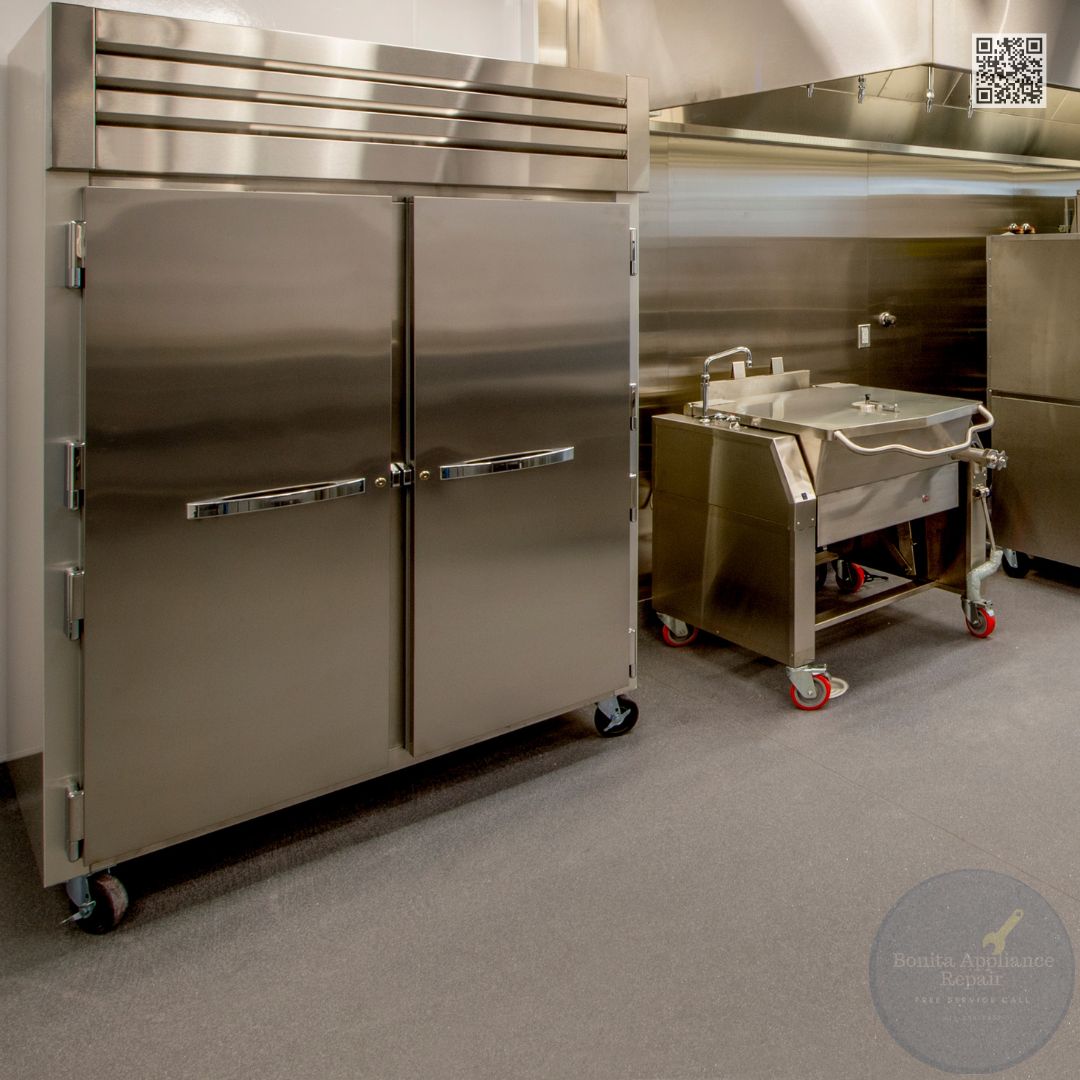
A commercial refrigerator that fails can cost a business its inventory in a few hours. Most failures give warning signs first: temperature swings, new noises, leaks, or frost.
This guide lists 15 signs that point to a repair, groups them by symptom, and explains what to do right away. Bonita Appliance Repair has served San Diego since 2012 and repairs commercial refrigerators, freezers, and ice machines.
What to do when you notice a problem
The FDA Food Code sets 41°F as the maximum cold-holding temperature for food.
- Check the temperature with a thermometer inside the unit. Do not rely on the display alone.
- Keep the door closed as much as possible so the cold air stays inside.
- Move perishable food to a working refrigerator or cooler if the unit is above 41°F.
- Follow your local health department’s rules on discarding food that was held above 41°F.
- Call a technician. Describe the symptom, the brand, and the model number.
Temperature and food safety signs
- 1. Temperature swings. Uneven cooling often comes from blocked vents, a failing compressor, or a faulty thermostat or sensor.
- 2. Spoiled food. Food that spoils early means the unit is not holding a safe temperature. Find the cause before you restock.
- 3. A rising energy bill. A dirty condenser coil makes the compressor run longer.
Water, frost, and ice signs
- 4. Water leaks. Common causes are a cracked drain pan, a clogged or frozen drain line, or a failing inlet valve on units with ice makers.
- 5. Condensation inside the unit. Excess moisture often points to a door seal that lets warm air in, or an evaporator coil problem.
- 6. Frost buildup. Heavy frost on the evaporator points to a defrost system fault, such as a failed heater, timer, or sensor.
- 7. Ice on the outside of the unit. Ice on the exterior often points to a leaking seal or a defrost problem.
Noise and heat signs
- 8. Unusual noises. Squealing, rattling, knocking, or buzzing usually comes from a fan motor, the condenser fan, or the compressor.
- 9. A hot exterior. A very hot cabinet often means the condenser fan has failed or the condenser coil is blocked.
- 10. A unit that is unusually quiet. If a compressor or fan that normally runs has gone silent, the motor or compressor may have stopped.
Door and seal signs
- 11. A torn or missing door gasket. A damaged gasket lets cold air escape, so the unit runs longer and warms up.
- 12. A door that does not close properly. A loose hinge, a warped door, or an unlevel unit can keep the door from sealing.
Close a dollar bill in the door at several points. If the bill slides out easily, the seal is not holding.
Age and repair history signs
- 13. Worn components. Rust, loose hinges, a cracked gasket, and long run times all point to an aging unit.
- 14. More frequent repairs. Repeated service calls for the same problem can mean a bad fan, a dirty coil, blocked vents, or a thermostat that was never fixed.
- 15. Repairs that cost more than half the price of a replacement. Compare the cost of the repair with the cost of a new unit. Read is it better to repair or replace an appliance.
Keep your commercial refrigerator running
Regular maintenance prevents many of these problems. Clean the condenser coil on a regular schedule, check the door gaskets, keep vents clear, and listen for changes in noise.
See commercial appliance repair, ice machine repair, and freezer repair for the equipment we service.
Frequently asked questions
What temperature should a commercial refrigerator hold?
The FDA Food Code sets 41°F as the maximum cold-holding temperature for food. Check the temperature with a thermometer inside the unit.
Why is my commercial refrigerator not cooling evenly?
Uneven cooling often comes from blocked vents, a failing compressor, a bad door seal, or a faulty thermostat or sensor.
What causes water to leak from a commercial refrigerator?
Common causes are a cracked drain pan, a clogged or frozen drain line, or a failing water inlet valve on units with ice makers.
Why is my commercial refrigerator so loud?
Squealing, rattling, or knocking usually comes from a fan motor, the condenser fan, or the compressor. A technician can locate the source.
Do you repair commercial refrigerators in San Diego?
Yes. Bonita Appliance Repair repairs commercial refrigerators, freezers, and ice machines in San Diego County. Call 619-329-5938 to confirm we service your equipment.
Book commercial refrigerator repair in San Diego
Bonita Appliance Repair diagnoses the fault and explains the repair and its price before any work begins. Call to confirm we service your equipment.
