
By the Bonita Appliance Repair service team · Last reviewed October 6, 2026
The kind of noise a washing machine makes, and when it makes it, points to the cause. Banging during the spin usually means an unbalanced load or worn suspension. A roar that gets louder as the drum speeds up usually means worn drum bearings. Grinding during the drain usually means something is caught in the drain pump.
This guide covers 10 causes of a loud washer, how to tell bad washer bearings from other problems, and which noises you can fix yourself. Bonita Appliance Repair repairs top-load and front-load washers in Bonita, Chula Vista, National City, and across San Diego County.
Match the noise to the cause
| Noise | When it happens | Most likely causes |
|---|---|---|
| Banging or thumping | Spin cycle | Unbalanced load, washer not level, shipping bolts left in, worn shocks or suspension (causes 1–4) |
| Roaring or rumbling that rises with speed | Spin cycle | Worn drum bearings (cause 5) |
| Grinding or rattling | Draining | Object in the drain pump, failing pump (cause 6) |
| Squealing or squeaking | Agitating or spinning | Worn belt or drive pulley (cause 7) |
| Clicking or clunking | Agitating | Motor coupling, agitator parts (cause 8) |
| Rattling or scraping | Any time the drum turns | Coins or underwire between the drum and tub (cause 9) |
| Loud bang in the pipes | When the washer stops filling | Water hammer in the home’s plumbing (cause 10) |
Banging or thumping during the spin
Safety note: Unplug the washer before you open the drain pump filter, turn the drum by hand, or remove any panel. Stop using a washer that bangs violently, leaks, or smells of burning.
1. The load is unbalanced
A single heavy item, or clothes bunched on one side, makes the drum swing off center during the spin. Most washers stop the spin and show an unbalanced code; others bang against the cabinet.
- Stop the washer and spread the load evenly around the drum.
- Wash heavy items such as rugs and comforters with a few towels, not by themselves.
2. The washer is not level
A washer that rocks on an uneven floor walks and bangs during the spin.
- Put a level across the top of the washer, side to side and front to back.
- Adjust the front leveling feet and tighten their lock nuts. Many washers have self-adjusting rear feet; tip the washer forward slightly and set it down to reset them.
- Press on each corner. The washer should not rock.
3. The shipping bolts are still in a new front-load washer
Front-load washers ship with transit bolts that lock the drum in place. If they are not removed, a new washer shakes violently and bangs on its first spin.
- Look for three or four bolts on the back panel of a new washer.
- Remove them as the installation instructions describe, and insert the plastic caps that came with the washer.
4. The shock absorbers, springs, or suspension rods are worn
Front-load washers hang the tub on springs and damp it with shock absorbers. Many top-load washers hang the tub on four suspension rods. Worn parts let the tub knock against the cabinet even with a balanced load.
Shocks and suspension rods are replaced as a set so the tub stays balanced.
Roaring during the spin: bad washer bearings
5. The drum bearings are worn
Worn bearings cause a roar that rises and falls with drum speed. The symptoms and checks below help confirm it.
Drum bearings let the inner drum spin smoothly on its shaft. A rubber tub seal keeps water away from them. When the seal wears, water reaches the bearings, washes out the grease, and the bearings rust and wear.
Symptoms of bad washer bearings
- A loud roar or rumble during the spin that gets louder as the drum speeds up
- Grinding when you turn the empty drum slowly by hand
- Play in the drum: on a front-load washer, the drum moves up and down when you lift and push the top edge
- Rust-colored streaks or water leaking from the back of the tub
How to check the bearings
- Unplug the washer and empty the drum.
- Turn the drum slowly by hand and listen for grinding or scraping.
- On a front-load washer, grip the top of the drum opening and push up and down. A small amount of movement from the springs is normal; a knock or clunk is not.
Bearing replacement means taking the washer apart and separating the tub. It is one of the most labor-intensive washer repairs. On some models the bearings are sold only as part of a complete outer tub, which raises the cost. Bearings should be replaced soon after the noise starts, since a failed bearing can damage the drum shaft and the tub.
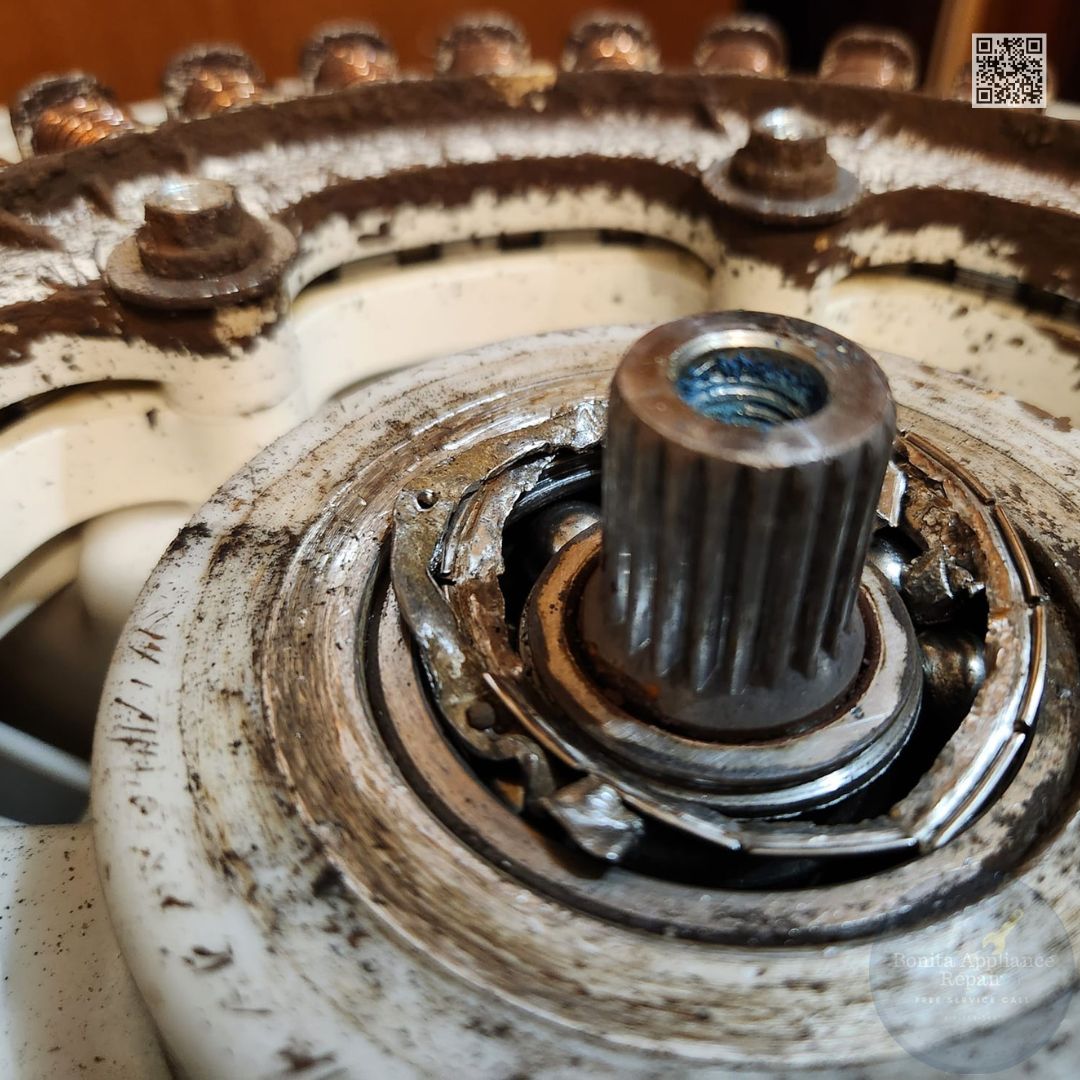
Grinding, squealing, clicking, and other noises
6. Something is caught in the drain pump, or the pump is failing
Coins, buttons, hair ties, and small socks get pulled into the drain pump. They rattle or grind during the drain and can stop the pump.
- On a front-load washer, unplug it, put towels and a shallow pan down, and open the drain pump filter at the bottom front.
- Remove debris and turn the pump impeller if you can reach it.
- Empty pockets before every wash.
If the pump still grinds or hums without draining, it needs to be replaced.
7. The drive belt or pulley is worn
Belt-drive washers use a belt between the motor and the drum or transmission. A glazed, cracked, or loose belt squeals, and a worn pulley can squeak or wobble.
A technician replaces the belt and checks the pulleys for wear.
8. The motor coupling or agitator parts are worn
Some top-load washers connect the motor to the transmission with a plastic and rubber motor coupling that wears out and clunks or grinds. Agitators with a separate top section use small plastic “dogs” that wear and click, and the top of the agitator stops turning.
These are inexpensive parts, but the washer cabinet or agitator has to be taken apart to reach them.
9. Coins or underwire are caught between the drum and the tub
Small metal objects slip through the drum holes or the front-load door seal and rattle or scrape between the drum and the outer tub.
- Check the folds of the front-load door seal.
- Spin the empty drum by hand and listen for something sliding.
If you hear an object but cannot reach it, a technician can remove the heater or a drum panel to get it out.
10. Water hammer in the plumbing
A loud bang in the walls when the washer stops filling comes from the home’s pipes, not the washer. The inlet valve closes quickly and the moving water slams to a stop.
- Check that the supply pipes are strapped securely in the wall.
- A plumber can install water hammer arrestors on the washer supply lines.
How much does washer repair cost in San Diego?
These are typical washer repair prices at Bonita Appliance Repair. The final price depends on your model, the failed part, and the time the repair takes.
| Washer repair | Typical price |
|---|---|
| Minor repairs: belts, small pumps | $150–$300 |
| Standard repairs: drain pumps, motor couplings, door and lid switches | $220–$580 |
| Front-load washer drum bearing and seal kit | $340–$620 |
See washer and dryer repair in San Diego for more repair prices.
Repair or replace a noisy washer?
The National Association of Home Builders puts the average life expectancy of a clothes washer at about 10 years (Study of Life Expectancy of Home Components, NAHB, 2007). Belts, pumps, shocks, and couplings are usually worth repairing. Bearing replacement is a closer call on an older washer, especially when the bearings come only with a new outer tub.
A common rule of thumb: consider replacing the washer if the repair costs more than half the price of a comparable new model and the washer is past half its expected life. Read is it better to repair or replace an appliance for more detail.
When to call a washer repair technician
Call a washer repair technician when:
- The washer roars during the spin, or the drum has play when you push it
- Banging continues with a balanced load and a level washer
- The drain pump grinds or hums after you clean the filter
- The washer squeals, clunks, or leaks from underneath
Bonita Appliance Repair offers washer repair in San Diego and washer repair in Chula Vista. We repair Samsung, LG, Whirlpool, Maytag, Kenmore, GE, Speed Queen, and Bosch washers. A technician diagnoses the noise and explains the repair and its price before any work begins.
Noisy washer FAQs
Why is my washer so loud when it spins?
Banging during the spin usually means an unbalanced load, a washer that is not level, or worn shocks or suspension rods. A roar that gets louder as the drum speeds up usually means worn drum bearings.
What does a washer with bad bearings sound like?
Bad washer bearings make a loud roar or rumble during the spin that rises and falls with drum speed. Turning the empty drum slowly by hand may also produce a grinding sound.
Can I still use a washer with bad bearings?
You can run it for a short time, but the noise will get worse, and a failed bearing can damage the drum shaft and the tub. Have it repaired soon after the noise starts.
How much does it cost to replace washer bearings?
At Bonita Appliance Repair, a front-load washer drum bearing and seal kit repair typically costs $340–$620. Models that require a complete outer tub cost more.
Why is my washer making a grinding noise when it drains?
Grinding during the drain usually means a coin, button, or other small object is caught in the drain pump. Clean the drain pump filter. If the grinding continues, the pump may be failing.
Does Bonita Appliance Repair fix noisy washers?
Yes. Bonita Appliance Repair repairs top-load and front-load washers from all major brands in Bonita, Chula Vista, National City, and across San Diego County. Call 619-329-5938 or book online.
Book washer repair in San Diego
If your washer is still loud after these checks, Bonita Appliance Repair can find the worn part and explain the repair and its price before any work begins.
Bonita Appliance Repair · 5080 Bonita Rd #22, Bonita, CA 91902 · 619-329-5938
